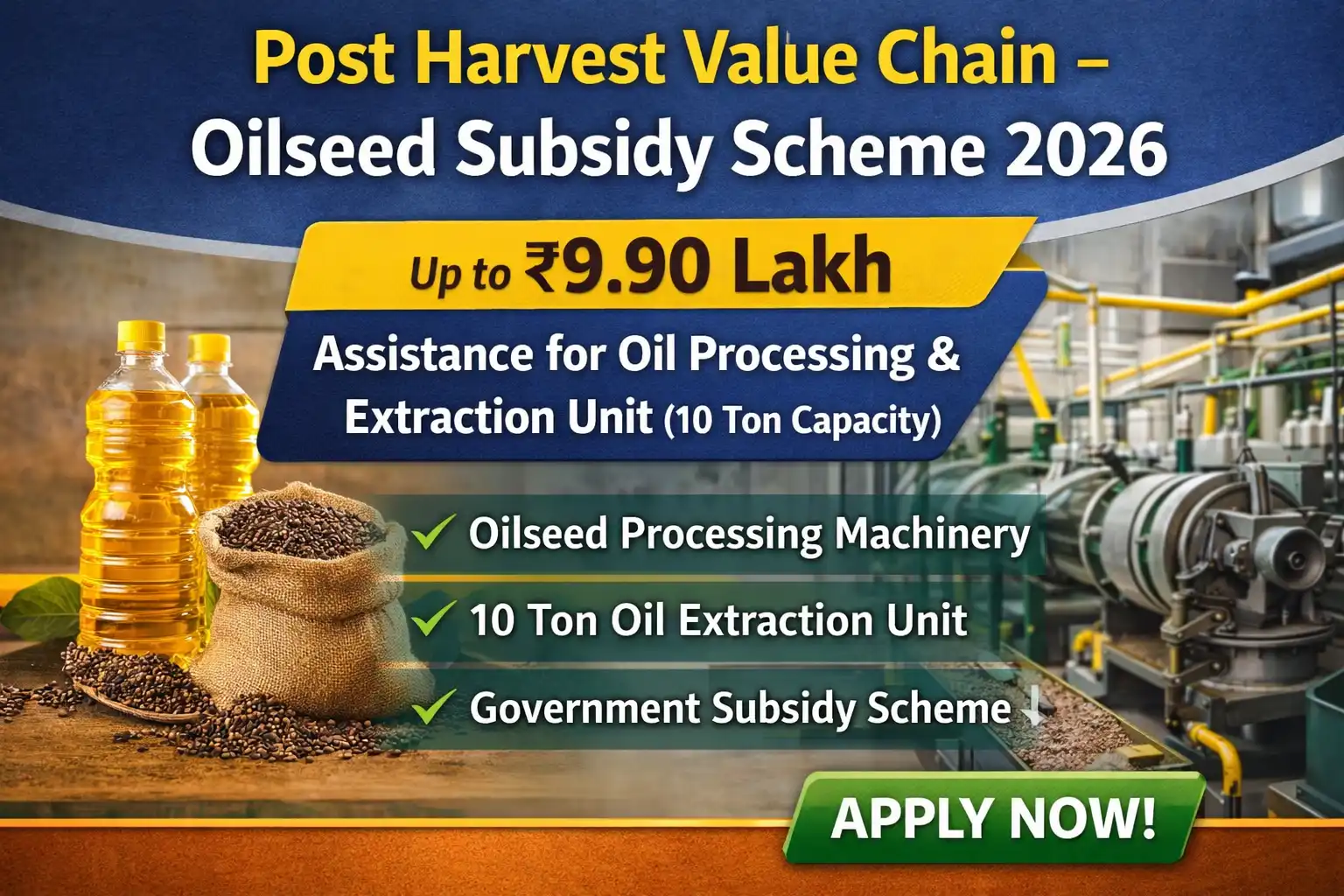
Post Harvest Value Chain Oilseed Subsidy 2026: The journey from a farmer’s field to a consumer’s kitchen is full of opportunities. However, for most small-scale farmers and rural entrepreneurs, the cost of entering the processing industry is often too high. Setting up an oil mill or a modern processing centre requires a significant financial push.
Recognising this gap, the government has rolled out the Post Harvest Value Chain – Oilseed Subsidy Scheme 2026. This initiative isn’t just a financial handout; it is a strategic investment in the future of India’s edible oil sector. If you have dreamed of starting your own oil extraction unit or upgrading your agricultural business, this scheme could provide the support you need—up to ₹9.90 lakh.
In this detailed guide, we will break down everything you need to know about this subsidy, how it works, and why 2026 is the best time to start your journey in the oilseed industry.
What is the Post Harvest Value Chain – Oilseed Scheme?
At its heart, this scheme is about “Value Addition”. Traditionally, farmers sell raw oilseeds (like mustard, groundnut, or soybean) to wholesalers at market rates. While this provides immediate cash, the real profit lies in the processed product—the oil.
The Post Harvest Value Chain – Oilseed program encourages farmers and rural youth to become “agri-preneurs”. Instead of just growing seeds, you are encouraged to clean, grade, and extract oil from them. By doing this locally, you reduce waste, create village-level jobs, and ensure that the profit stays within the farming community.
Why focus on oilseeds?
India is one of the world’s largest consumers of edible oil, yet we rely heavily on imports. By supporting local extraction units, the government aims to make the country Atmanirbhar (self-reliant) in edible oils.
Objectives: What Does the Government Want to Achieve?
This scheme isn’t just about giving money; it has specific goals designed to strengthen the rural economy:
-
Cutting Down Post-Harvest Waste: Oilseeds are perishable if not stored or processed correctly. Local units help process crops immediately after harvest.
-
Boosting Domestic Production: The more local mills we have, the less we need to import oil from other countries.
-
Encouraging Modernisation: The subsidy is tied to purchasing high-quality, efficient machinery that produces better oil with less energy.
-
Farmer Empowerment: By helping farmers own the processing units, the government ensures they get a bigger slice of the final retail price of the oil.
Financial Support: Breaking Down the ₹9.90 Lakh Subsidy
The financial assistance provided under this scheme is designed to cover a substantial portion of your capital investment. Here is how the maths works.
The Subsidy Formula
The government provides a capital subsidy based on the following rules:
-
33% of the total project cost, OR
-
A maximum cap of ₹9,90,000.
Let’s look at two examples to make it clear:
-
Example A: You plan a small unit with a total cost of ₹20 lakh. 33% of ₹20 lakh is ₹6.6 lakh. Since this is below the cap, you receive the full ₹6.6 lakh as a subsidy.
-
Example B: You plan a larger, more advanced unit costing ₹40 lakh. 33% of ₹40 lakh is ₹13.2 lakh. However, because the scheme has a maximum limit, you will receive the ceiling amount of ₹9.90 lakh.
Important Dates: The Window is Narrow!
One critical thing to remember about government subsidies on the i-Khedut portal is that they operate on a “first-come, first-served” basis within specific timeframes.
-
Application Start Date: 19 January 2026
-
Application Deadline: 31 January 2026
With only a 12-day window, preparation is key. If you are reading this and the dates are approaching, you should start gathering your documents immediately.
What Equipment and Units are Covered?
The subsidy isn’t just for a single machine; it supports the entire infrastructure needed for a professional setup.
1. Oilseed Processing Machinery
This includes tools used to prepare the seeds before extraction:
-
Cleaning & Grading Units: To remove dust, stones, and low-quality seeds.
-
Decorticators: To remove the outer shells of seeds like groundnuts.
-
Roasters/Conditioners: To heat the seeds to the perfect temperature for maximum oil yield.
2. 10-Ton Capacity Oil Extraction Unit
This is the “star” of the scheme. A 10-tonne capacity is a perfect “sweet spot” for a rural business—large enough to be profitable but small enough to be manageable. Supported components include:
-
Oil Expellers: The main machine that presses the seeds.
-
Filter Presses: To ensure the oil is crystal clear and free of particles.
-
Storage Tanks: For both raw oil and filtered final products.
Who is Eligible to Apply?
The government wants to encourage a wide variety of people to join this mission. You can apply if you are:
-
An individual farmer with a valid 8-A or 7/12 land record.
-
A member of a Farmer Producer Organisation (FPO) or Cooperative Society.
-
A rural entrepreneur looking to start an agri-start-up.
-
A small business owner who wants to upgrade an old, inefficient oil mill to modern standards.
How to Apply: The i-Khedut Process
In Gujarat, the i-Khedut portal is the central hub for all agricultural subsidies. The process is transparent and digital.
-
Gather Documents: You will need your Aadhaar card, bank passbook, land records, and a detailed “Proforma Invoice” (a quote) from a registered machinery dealer.
-
Online Registration: Log in to the i-Khedut portal during the application window.
-
Fill the Form: Select the “Post Harvest Value Chain – Oilseed” component under the Agriculture Schemes section.
-
Submit & Print: Once you submit the online form, take a printout.
-
Physical Submission: Usually, you must submit the signed printout and document copies to your local District Agriculture Office within a week of the online application.
Expert Advice for a Successful Application
Since these schemes are competitive, following these tips can help your application get approved:
-
Get a Professional Quote: Don’t just guess the price. Get a formal quotation from a manufacturer who is approved by the government.
-
Check the 10-Tonne Limit: Ensure your project plan specifically mentions the capacity requirements stated in the guidelines.
-
Link Your Aadhaar: Ensure your bank account is linked with your Aadhaar for smooth Direct Benefit Transfer (DBT).
-
Plan Your Location: The subsidy often does not cover land and building costs, so ensure you have a space ready for the machinery.
The Human Element: Changing Lives in Rural India
Imagine a group of 10 farmers in a small village who grow mustard. Usually, they sell their crop for a fluctuating market price. With this scheme, they can pool their resources, get a ₹9.90 lakh subsidy, and set up a mill.
Now, they don’t just sell mustard; they sell “Pure Village Mustard Oil”. They can package it, brand it, and sell it in nearby towns. This is how the Post Harvest Value Chain – Oilseed Subsidy Scheme 2026 changes lives—by turning producers into providers.
Conclusion
The Post Harvest Value Chain – Oilseed Subsidy Scheme 2026 is more than just a financial break; it’s an invitation to grow. With a potential support of nearly ₹10 lakh, the barrier to entry for the oil processing industry has never been lower.
If you have the drive to build an agribusiness that supports your family and your community, mark your calendar for January 19, 2026. Prepare your project, get your documents in order, and take the first step toward becoming a leader in India’s edible oil revolution.